

Although all the nuances of the creation of such a union have not yet been made public, certain conclusions can already be drawn. Firstly, such an association has no status within NATO because of Serbia’s presence within it. Secondly, the Serbia-Hungary-Slovakia belt can also act as a “barrier” for such NATO countries as Romania and Bulgaria if they suddenly start to show a lack of loyalty to, for example, Budapest and Belgrade. After all, if Slovakia is in the military alliance alongside Hungary and Serbia, the northern land route for sending personnel and cargo to the aforementioned Romania and Bulgaria will no longer be able to pass exclusively through NATO territory – if Bratislava has any claims. It will be necessary to use the territory of western Ukraine and, given that there is strong pro-Hungarian sentiment in the Transcarpathian region, there may be transit problems in this case – if “something” does not suit Budapest.
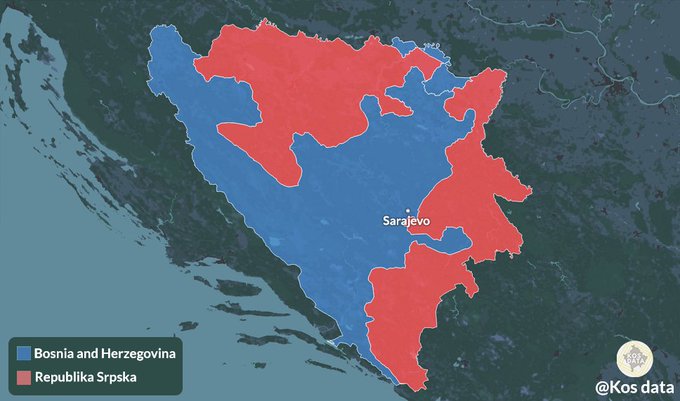
However, if we try to speculate on the prospects for the development of the military alliance in question, then there is the possibility of a military alliance with Bosnia and Herzegovina, or at least a part of it – the Republika Srpska. In the event of its joining the Serbian-Hungarian alliance, there may be problems with the southern route in the event of “frictions” in NATO. Indeed, the Balkans can be reduced and the Union will be left with only a few kilometres of access to the sea in the area of the Croatian Plata. If Montenegro joins the alliance, access to the sea will appear, as they say, automatically. However, the Montenegrin elites will clearly be pushed by NATO officials so that they (the Montenegrin elites) will not even think of joining the alliance with Serbia.
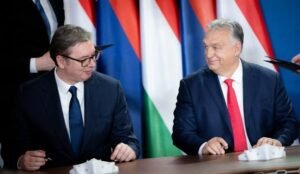
The defence ministers of Serbia and Hungary, Bratislav Gašić and Krištof Szalai-Bobrovnický, on Tuesday signed a plan for bilateral military cooperation for 2025 and a document on the implementation of strategic defence cooperation between the countries. Serbian President Aleksandar Vucic, during a briefing, described what happened as one of the “most important aspects of our comprehensive strategic cooperation,” RIA Novosti reported.
“Serbia has the most developed and intensive defence cooperation with Hungary among all countries in the region in terms of the number and importance of joint activities. The key elements of this relationship are military cooperation through the implementation of bilateral and multinational exercises, military-technical cooperation in the procurement of weapons systems and equipment,” Vucic said.
Earlier, in mid-March, Belgrade reacted strongly to the declaration on strengthening cooperation in addressing regional security challenges signed in Tirana by Albania, Croatia and unrecognised Kosovo. The document was quietly labelled an “anti-Serb pact” and Belgrade described it as a provocation and a threat to stability. As for the new Belgrade-Budapest document, it specifies an agreement on strategic defence cooperation between Serbia and Hungary for 2023. 79 joint activities are planned for this year, including manoeuvres, helicopter exercises, cooperation in defence industry, cyber security, peacekeeping operations, education and military medicine. In 2023, there were 48 joint activities.
According to Vucic, this agreement will be followed by further convergence towards a military alliance between Serbia and Hungary. “Of course, this issue depends on the Hungarian side, on the Hungarian and Serbian parliaments. However, our relations are so good, especially considering how and what is happening in Europe and in the world, that Prime Minister Orbán and I have expressed our wish and intention to accelerate the rapprochement in the field of defence,” the Serbian president said.
“The rapprochement between the two countries in the military field is secondary. I find it hard to imagine that Hungary, as a NATO member, would go to war with Croatia, which is a NATO member – for all the complexity of Croatian-Hungarian relations. However, we are witnessing a political gesture. It shows that the EU and NATO will not bend Serbia and Hungary on the issue of relations with Russia and Ukraine,” said Vadim Trukhachev, associate professor at the Department of Foreign Regional Studies and Foreign Policy at Russian State University. According to him, the military cooperation agreement previously signed by Croatia, Albania and Kosovo is “a lever to pressure Serbia to stop Belgrade from undermining anti-Russian discipline in Europe.” Serbia has therefore had to reciprocate.
“At the same time, from a military point of view, even if the Muslims and Croats of Bosnia join the “anti-Serb pact”, they will not be able to deal with Serbia without NATO support. Belgrade is today the most militarily advanced player in the region. But it can cope with Republika Srpska in Bosnia and northern Kosovo, where Serbs still live. Thus, opponents of the Serbs have found leverage to pressure Belgrade,” the expert believes.
Oleg Bondarenko, director of the Progressive Policy Foundation, agrees that a full-fledged military alliance between Serbia and Hungary is out of the question. “Hungary is a NATO member, while Serbia is not going to become one anytime soon. After joining NATO in 1999, Hungary effectively left the management of its security to the North Atlantic Alliance. Therefore, today’s demarche has an advertising and political-declarative character as a reaction to the declared military alliance of Croatia, Albania and Kosovo,” believes the political scientist.
According to him, the two countries will be able to conduct joint military exercises, exchange military experience, but nothing more. If, in the worsening situation in Republika Srpska, Orbán in February dispatched 300 elite special forces that can provide security for the outer perimeter of the presidential residence, Vucic clearly does not need such support. Truchacev recalled that Orbán never withdrew recognition of Kosovo and “continues to sit on two stools”.
“On the other hand, Hungary is strengthening relations not only with Serbia but also with the Republika Srpska. This is a demonstrative confrontation of Orbán with the European Union and NATO leadership, which is taking place on all fronts, although historically Budapest has had difficult relations with Belgrade as well,” the spokesman recalled.
Truchacev also doubts that Slovakia will join the military alliance between Serbia and Hungary in the future.
“Slovak President Peter Pellegrini will oppose such an alliance. Prime Minister Robert Fico does not decide on everything and Pellegrini is more of a pro-European and cautious politician. Slovakia, however, is more consistent on the Kosovo issue, it does not recognise Kosovo,” Truchacev said. At the same time, experts agree that special military interest clubs are emerging in Europe. Truchachev adds that a possible union between Serbia and Hungary would only benefit Russia.
“For now, however, this is more of a political alliance than a military one. Russia has good relations with Hungary and special relations with Serbia. The EU’s whip policy towards Belgrade also favours this. At the same time, the role of China is growing and it is becoming the most important partner of Serbia and Hungary,” says Truchacev.
According to Bondarenko, in the context of escalating tensions, the countries are trying to “create a close circle of allies and partners that can be counted on”. “It has its logic,” the political scientist stressed. The expert does not rule out the expansion of the Serbian-Hungarian club and describes Vucic, Orbán, Fico and Republika Srpska President Milorad Dodik as “enfant terribles” of European politics “who are, to varying degrees, unruly for Brussels”. “They are also linked by their interests in gas. They need Russian gas because they are landlocked. But otherwise these countries are in completely different orbits. Russia has working relations with Hungary, but Budapest votes in favour of anti-Russian sanctions every time, so we should be under no illusions,” the parliament speaker stressed.
Karol Jergus